
Calibration and quality control
Calibration procedure done at the factory
The RhoC5 is calibrated to measure soil densities ranging from 1.0 kg/l to 2.1 kg/l under field conditions. To ensure accurate calibration, the sensor is first calibrated using Monte Carlo simulations in combination with a reference measurement in water. Following this calibration, the sensor is validated using calibration blocks with different, known densities.
Calibration of the RhoC5
The calibration of the RhoC5 density sensor combines Monte Carlo simulations with a reference measurement in water. First, a detailed Monte Carlo model is constructed of the detector and the environment. Using this model, gamma spectra are simulated for homogeneous media with densities ranging from 1.0 to 2.1 kg/l. The simulated spectra represent the theoretical detector responses for these material densities.
Next, a reference measurement is performed with the detector fully submerged in water, ensuring at least 15 cm of water surrounds the sensor. This measurement is used to derive a function that maps channel numbers to energy values, using spectral features such as the Na-22 photo-peaks. By summing the content of the gamma spectrum within a fixed energy window, a count rate can be determined for the reference measurement.
Finally, the measured count rate is compared with the simulated responses. A fit is derived that relates the count rate to density, resulting in a set of calibration parameters for the RhoC5.
Validation of the density calibration
After calibration, the sensor measurements are validated using calibration blocks made of aluminum (2.7 kg/l), HMPE (0.93 kg/l), and PVC (1.43 kg/l). The measurements are considered valid when the measured densities deviate by no more than 5% from the expected densities.
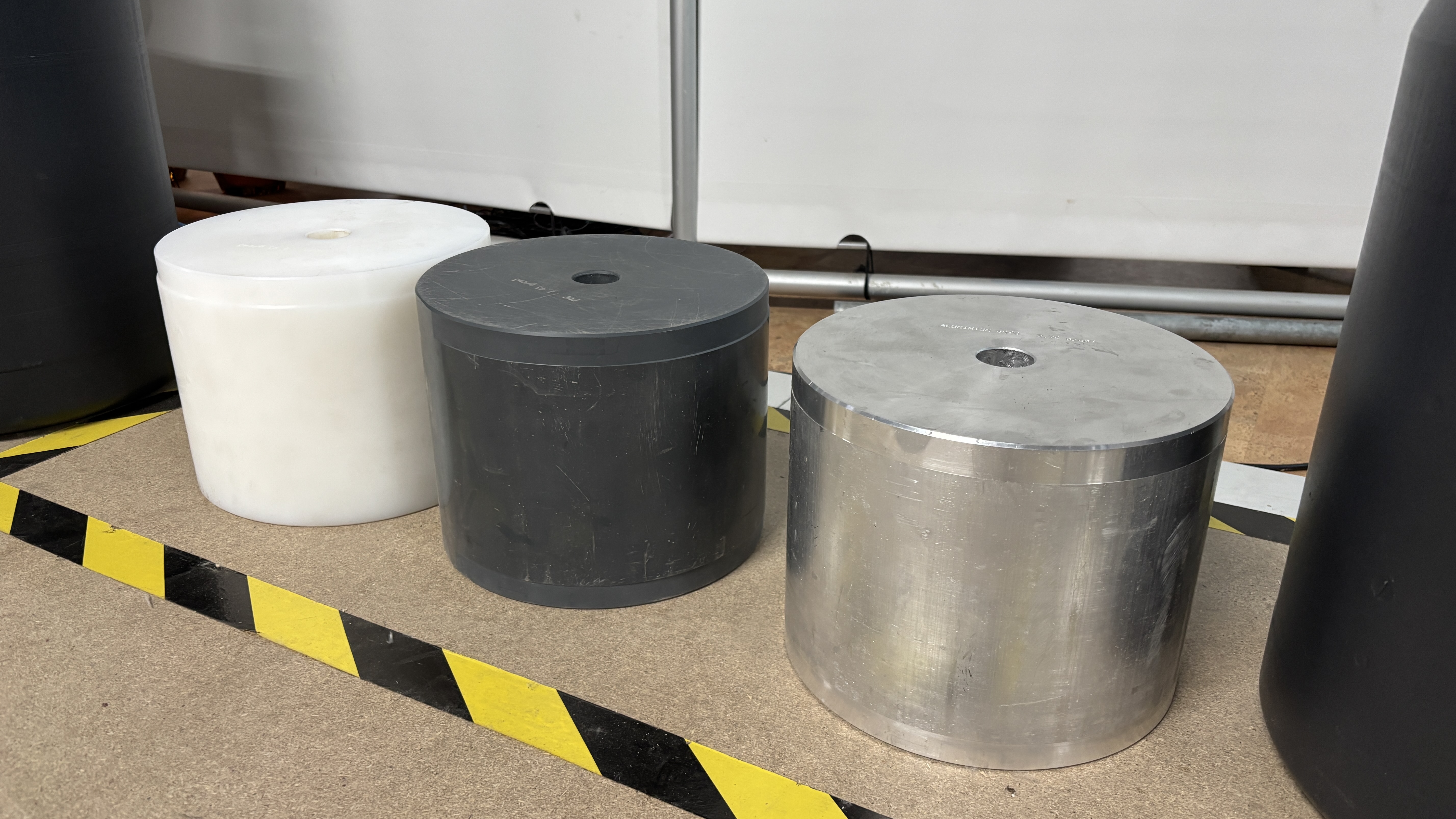
The calibration blocks of HMPE, PVC and Aluminum.
Validation for in situ measurements for soil
The RhoC5 portable gamma ray sensor was compared with traditional ring sampling in two Dutch agricultural fields with a clay and sandy soil.
Measurements across 30 profiles and 180 measurements showed relative uncertainties of 9% for Kopecky rings and 15% for the RhoC5, per field.
More information can be found here: https://bsssjournals.onlinelibrary.wiley.com/doi/10.1111/ejss.13542.
Quality control
The sensor is factory-calibrated and does not require additional calibration before use. To verify proper functioning, you can perform a quick check by placing the sensor in a bucket of water. Ensure it is fully submerged with at least 10 cm of water surrounding the probe. Under these conditions, the field bulk density reading should be approximately 1.11 kg/l.
This apparent density is slightly higher than the true density of water (1.00 kg/l) because the RhoC5 sensor effectively measures electron density, not mass density. Hydrogen atoms, which are abundant in water, have a higher electron-to-mass ratio than other elements. As a result, water appears denser in the sensor’s readings.
In soil measurements with very high moisture content, this effect can cause the field bulk density to be overestimated by approximately 0.11 kg/l at 100% water content. For example, a volumetric water content of 50% would result in an overestimation of about 0.055 kg/l. This deviation is within the typical uncertainty range of the moisture measurement, and therefore no automatic correction is applied.
When results look unrealistic, contact the Medusa help desk.