
Moisture corrections for soil type
The moisture measurement is based on a capacitive measurement that relies on the dielectric constant (also known as relative permittivity). The dielectric constant measures a material’s ability to store electrical energy in an electric field, relative to a vacuum. It indicates how much electric charge the material can hold when exposed to such a field. The dielectric constant is different for different materials:
Air: ~1
Water: ~80
Dry Soil: Typically between 2 and 5, depending on the soil type
By measuring the combined dielectric constant of the soil and its moisture, the RhoC5 sensor estimates the volumetric moisture content. However, the dielectric constant of dry soil depends on the soil composition, such as whether the soil is sandy, clayey, or rich in organic material. This means the soil type influences the moisture measurement.
The RhoC5 moisture sensor is calibrated with an air/water calibration, where a measurement in air reads 0% moisture, and a measurement in water reads 100%. Since the soil has a dielectric constant that is higher than the dielectric constant of air, a measurement in dry sand will give an apparent moisture content of 26%. Therefore, the RhoC5 moisture sensor has factory settings that correct for a typical Dutch sandy soil, which provides a good approximation for many soils worldwide. However, variations in local soil composition may cause deviations in measurements. These settings are only included in the sensors with a firmware version starting with number 24.1 . If you are not sure which firmware version you have, please ask the helpdesk.
The graph below shows the reported volumetric soil moisture content, in relation to the real soil moisture content. This demonstrates that the soil moisture will be overestimated in soils with a high clay content and underestimated in soils that are rich in organic materials.
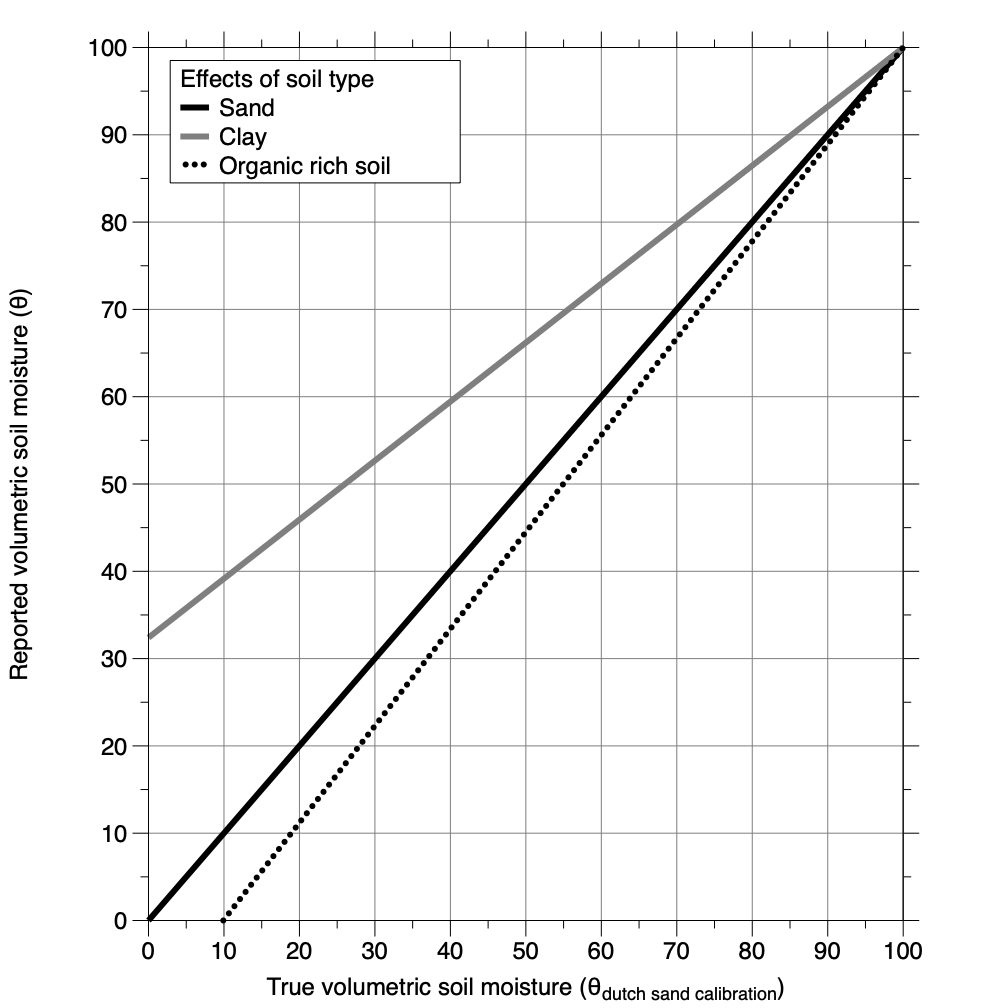
Differences in soil types can result in deviating soil moisture contents.
We recommend taking calibration samples for the specific soil the RhoC5 is used in and derive a site specific soil moisture correction function.
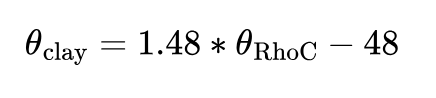
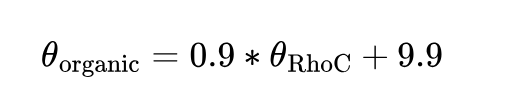
Based on the general soil type described above, we can give the following general corrections that can be used. However, please note that exact values can deviate, depending on the exact soil type of the location.
Correction for a clay rich soil:
Correction for an organic rich soil:
This soil moisture content can be adapted to local conditions in two ways. First, the soil moisture values can be converted using an external program, such as Microsoft Excel. Second, a user-defined moisture content, θuser, can be specified by implementing a custom function on the device. This function translates the moisture content derived for a Dutch soil into a value that more accurately represents local soil conditions, according to:
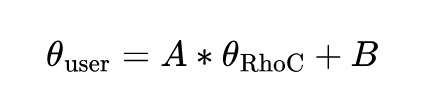
The constants in this formula can be changed by going to the RhoC5 section on the Settings page in the mDOS web interface. For more information on mDOS and how to access the web interface, please visit the mDOS manual.