
gSMS
gSMS — Soil Moisture Sensor
The Medusa gamma Soil Moisture Sensor (gSMS) is a stationary gamma-ray spectrometer designed to measure soil moisture content over time. It is primarily used in agriculture to support irrigation decision-making.
The gSMS uses the same mDOS interface as all other Medusa detectors, with a few differences in measurement behaviour and data handling described in this chapter.
How the gSMS Works
The gSMS records data at a lower frequency than a mobile survey detector, suited to its stationary use case:
60-second interval — the spectrometer, GPS (optional), and PTH (optional) record at a 60-second interval. All data within each interval is summed (spectrometer) or averaged (GPS and PTH).
15-minute summation — fifteen consecutive 60-second spectral readings are summed and synchronised with a GPS and PTH reading. The summed record is analysed and radionuclide concentrations are derived.
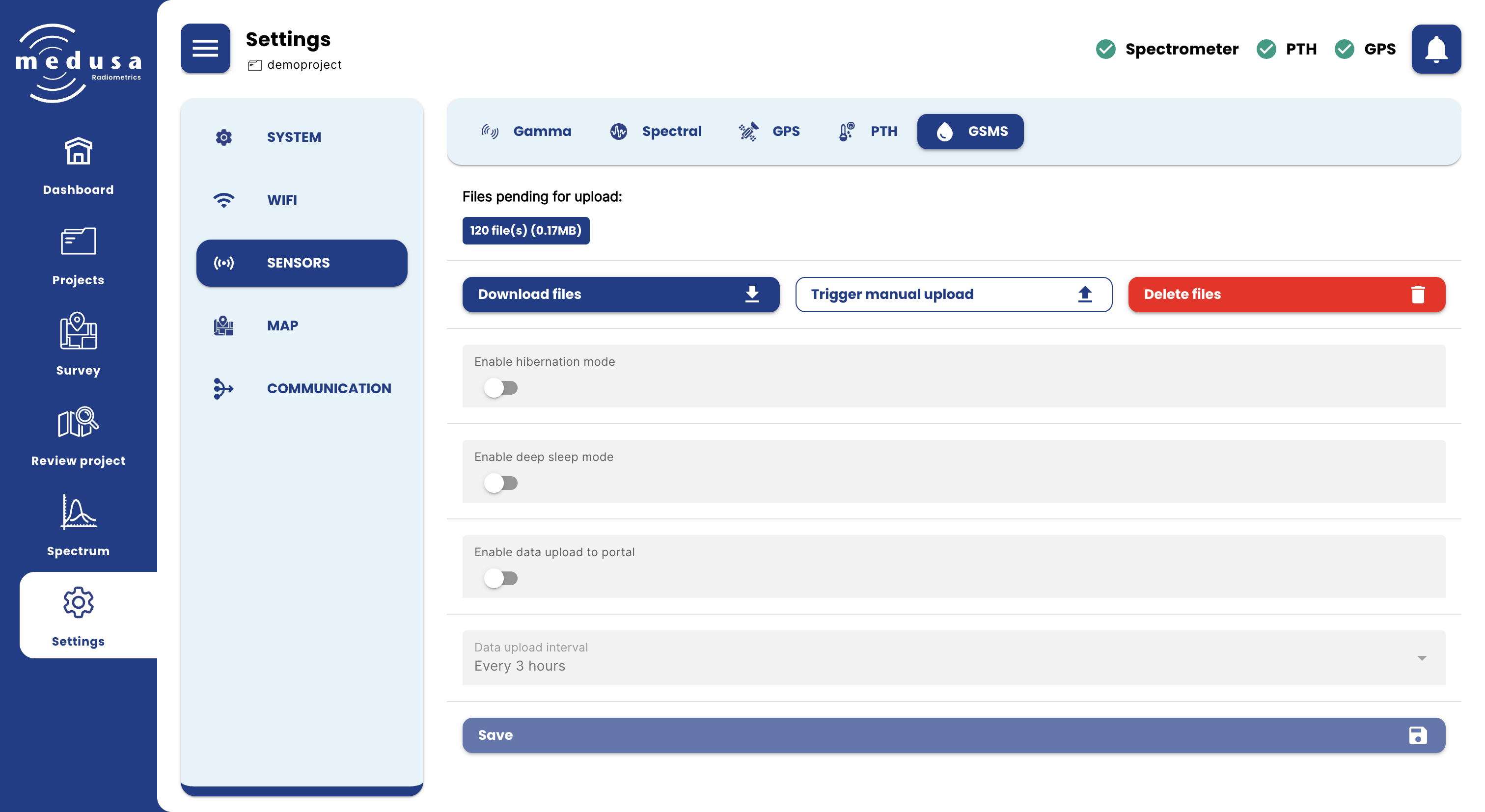
3-hour upload — the 15-minute data is uploaded to the online Medusa portal at 3-hour intervals.
Installation
The gSMS sensors are supplied with MDC-80x cables. When power is connected, the sensor starts automatically.
[IMAGE: Photo of the gSMS sensor mounted on a pole with the mounting clamps, connector facing down]
Mount the sensor with the connector facing down to prevent moisture from entering through the PTH sensor opening. The sensor is supplied with mounting clamps that fit poles with a diameter of 50 mm.
Connecting to and accessing the mDOS interface works the same as for any other Medusa detector — see Connecting to the Detector.
Power Saving Mode
After 70 minutes, the gSMS enters a power saving mode: the LEDs, WiFi access point, and data uplink are turned off. Only data recording continues.
To access the interface after the sensor has entered power saving mode, either:
Connect via the wired Ethernet port, or
Power-cycle the sensor to restart it
Battery Monitoring
The gSMS can monitor the voltage of the battery powering the sensor. The sensing wires must be connected directly to the positive and negative terminals of the battery. The sensor reads the voltage; the online portal converts this to a battery percentage. See the MDC-80x pinout documentation for the wiring specification.
Data Upload to the Portal
The gSMS uploads its 15-minute summed data to the Medusa portal at 3-hour intervals, starting at midnight GMT — uploads are attempted at 03:00, 06:00, 09:00, and so on. If a connection is established, all data on the sensor is uploaded. If no connection is available, data remains stored on the sensor until the next upload attempt.
When the sensor is powered and connected, a manual upload can be triggered from the Dashboard via the gSMS block.
Data can also be manually downloaded or deleted through the same gSMS block on the Dashboard.
The gSMS Portal
The gSMS portal is available at gsms.medusa-online.com. Access requires an account provided by Medusa, to which the detector is affiliated.